Heating Oil
Revision
Tank inspection with visual cleaning
Sillerebühl
There are two standard procedures in the field of tank inspection:
- Tank overhaul with internal cleaning
- Visual inspection (also often referred to as tank inspection)
Both measures must be carried out regularly every ten years and reported to the cantonal water protection office. Exempt installations and tank installations in water protection zone B are exempt from this – here the responsibility for compliance with the inspection obligations lies entirely with the owner of the installation.
We recommend tank revision with internal cleaning as it offers significant advantages:
- It ensures the complete removal of sludge, water or other impurities from the inside of the tank.
- The risk of clogging of filters and burner nozzles can be minimized.
- Optimized combustion contributes to environmental protection.
- Possible damage or corrosion in and on the tank can be detected at an early stage.
- We thus guarantee the long-term operational safety of your tank system.
- They ensure that your property retains its value.
- Insurance cover remains guaranteed and personal responsibility is released.
Carrying out a tank inspection with internal cleaning every ten years is of great benefit for the long-term protection of your system.
The natural temperature fluctuation in the tank leads to the formation of condensation. This combines with the smallest oil particles to form a sludge. This oil sludge acts as an electrolyte and initiates a Corrosion process that jeopardizes the substance of the tank over time. There is also a risk of this sludge developing into microbial deposits, which can lead to malfunctions in the heating system (blockage of filters or burner nozzles).
We remove these corrosion-promoting deposits with the internal cleaning and dispose of them in an environmentally friendly manner in accordance with legal regulations. After cleaning, your tank system is subjected to a thorough condition inspection. This includes a check of all critical safety components, such as the filling safety device, the structural condition of the tank compartment and the leak detection device.
Workflow:
A visual inspection of heating oil tanks is an external, visual inspection of the tank, the supply lines and the tank compartment for condition and tightness, which is required at least every 10 years for systems requiring a permit.
We recommend a visual inspection only for tanks that will be removed or taken out of service within the next 3 years.
No liability can be accepted for any defects and the resulting damage.
Do you have any questions or would you like a personal consultation? Contact us – together we will find the best solution for you.
Refurbishment
Careful analysis, planning and subsequent implementation are necessary before any measures are taken. We provide you with a sound basis for decision-making by carrying out comprehensive investigations and drawing up a detailed quotation. We differentiate between the following renovation measures Small tank systems, buried tanks and tanks, which are Tank room are placed. You can find all the necessary information on tank refurbishment here. Do you have any questions or would you like a personal consultation? Contact us now – together we will find the best solution for you.
Refurbishment with inner tank shell
Here you will find everything you need to know about tank refurbishment.
Do you have any questions or would you like a personal consultation? Contact us now – together we will find the best solution for you.
New tank systems
The design and planning of a new tank system, regardless of its size, requires a high level of specialist knowledge and experience. By working closely with specialist planners and tank manufacturers, we can offer you a wide range of tank systems:
- PE combi tanks: Space-saving plastic tanks, equipped with a drip tray.
- Individual tanks made of plastic, available in steel or polyester drip pans.
- Battery tank systems (consisting of several individual containers).
- Steel tanks for cellars (can be welded on site or in the factory).
- Cylindrical steel tanks for underground installation, suitable for storing a wide range of media such as heating oil, diesel oil, petrol, HVO, AdBlue, water and rainwater.
- Spherical tanks for underground installation.
Based on your requirements, the available space, construction plans or an on-site inspection: We will find the optimal and legally compliant solution for every situation.
New plant
Do you have any questions or would you like a personal consultation? Contact us – together we will find the best solution for you.
Line construction
When installing new systems or making changes to existing tank systems, professional planning and installation of the corresponding lines is required. We plan and install the following lines professionally:
- Vent lines
- Product lines (with or without monitoring system)
- Vapor recovery lines
- Burner lines
- Water pipes (exclusively for rainwater or gray water)
On request, we can also coordinate the collaboration with the construction management and the tradespeople involved.
Line construction Fuels snow groomer
Do you have any questions or would you like a personal consultation? Contact us now – together we will find the best solution for you.
Decommissioning the tank
The professional decommissioning of your tank system must be carried out by a specialist. This regulation applies to all officially approved tanks in which water-polluting liquids have been stored.
The following process steps are carried out during decommissioning:
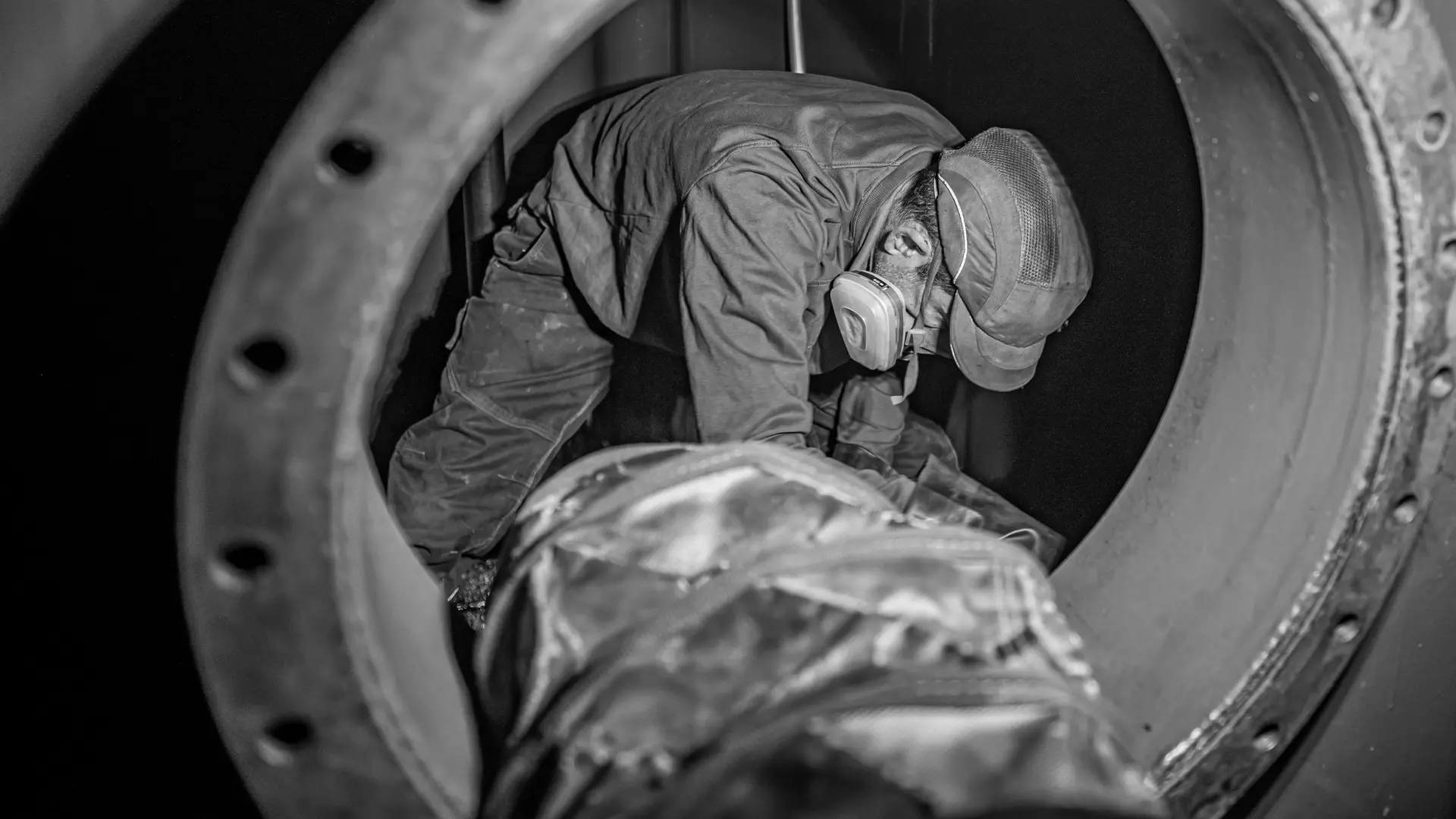
- Removal of residual oil and sludge from the tank.
- Professional de-oiling and de-gassing of the tank body.
- Cleaning or flushing the product lines including the tank cap.
- Ensure that the tank cannot be refilled by mistake ("shut off" lines).
- Formal deregistration of the tank with the responsible authorities.
- Carrying out any covering work for the tank access.
- Creation of dust protection walls.
- Ensure that the tank compartment is ventilated.
- Consistent compliance with all safety regulations.
- Instruction sheet for the inspection of newly constructed storage facilities
 Download information sheet on the inspection of newly created storage facilities
Do you have any questions or would you like a personal consultation? Contact us – together we will find the best solution for you.
Dismantling
Tank dismantling using the cold process
Tank disassembly
Tank disassembly
The dismantling of your tank must always be carried out by a qualified specialist. This regulation applies to all officially approved tanks for the storage of water-polluting liquids.
The following work is carried out during disassembly:
- Ensuring access to the tank and covering floors and walls if necessary
- Ventilation of the tank compartment
- Dismantling the tank into individual transportable parts
- Compliance with all safety regulations
- Compliance with safety regulations
We dismantle tanks almost exclusively using the cold process. In special cases, we cut with acetylene and oxygen. Normally, we “gnaw” and dismantle the tanks using special machines. Big advantage: no smoke development and soot deposits. Last but not least, the process is also less stressful for our employees.
Do you have any questions or would you like a personal consultation? Contact us now – together we will find the best solution for you.

Frequently asked questions
When is a tank inspection with internal cleaning recommended?
We recommend that you overhaul a heating oil tank every ten years, including internal cleaning.
Where can the date of the last revision be viewed?
The date of the last work carried out can be found on the sticker attached to the tank compartment door.
Are there additional costs for a tank overhaul in winter?
No. We will provide you with a provisional heating system free of charge, provisional oil feed for the heating.
I have only recently filled the tank. What is the maximum amount of oil that can be removed without additional costs?
The maximum quantity that can be removed free of charge is 15,000 liters. However, it is essential that we receive detailed information about your stock so that we can plan the correct tank trailer for temporary storage. The simplest method of measurement is to use the dipstick.